KAI Engineering
KERF
the engineering engine · deterministic · gate-proven
Named for the kerf — the width a saw blade eats out of the board. It is the smallest
detail a factory must respect, and the detail level this engine thinks at: Kerf even nests its cut-sheets
around the blade's own width.
LIVE · auto-derived from the engine itself
// Mission
Be the gate before manufacturing. Kerf turns professional engineering knowledge —
manufacturer planning data, EN / BIFMA / AWI / ISTA standards, published span-and-load rules —
into deterministic derivers, so every cabinet is computed, never sketched: cut-lists, System-32
drilling, hardware fits, physics checks and 3D assembly proofs, all from cited sources. Nothing reaches
a factory, a catalogue or a public page as "buildable" until every check an engineering office would run
has run and passed. The department learns one new discipline every day from authoritative sources —
and when real manufacturing disagrees, the knowledge base is corrected, never argued with. Built for the
KA-AI furniture line first; serves every KA AI project.
// The engineering, live —
// Professional knowledge — the library it reasons from
Every number Kerf uses lives as a knowledge
record with a cited authoritative source — and a record only counts once it is wired: a deriver
consumes it, a drift-guard test pins the engine's copy to it, a gate judges with it. Unwired knowledge
halts the lane.
Sources doctrine: manufacturer planning data (Blum · Hettich · Häfele · Accuride · Grass),
standards bodies (EN 14749 · BIFMA · AWI/AWMAC · ISTA), board-stock datasheets, established engineering texts.
Never a guessed number — a missing fact is a research task, not an estimate.
Learning next (the factory-QA gap hunt): tolerance stacking · screw & cam pull-out in MFC ·
edge-band adhesion · hinge-cup blow-through · runner install tolerance · case squareness · flat-pack drop
standards · MFC moisture movement in HK humidity · anti-tip hardware · melamine chip-out feeds — one
discipline lands per day, forever.
// The gate — 7 checks before anything ships
The newest check is the assembly crash gate: every part is placed into one 3D frame
and the engine must prove no two parts occupy the same space — at blueprint time, not after CNC and
assembly. On its first day it caught a real inconsistency in the drawer part set and corrected it before
anything was ever cut. A failed audit is loud; it can never be skipped quietly.
// Advancement — how the engine grew
JUN 2026
The deterministic core
Frameless carcass deriver · System-32 shelf drilling · edge-banding rules · back grooves — the first cabinets computed end-to-end from outer dimensions.
JUN 2026
Hardware engineering
Seven drawer-runner families (Accuride · Blum TANDEM / MOVENTO / LEGRABOX · Hettich Atira / ACTRO · Grass NOVA PRO) each sized from its manufacturer's own planning formula; hinges, lift-ups, joinery fits — all through one hardware gate.
JUN 2026
Physics & process
Tip-over, shelf deflection and drawer dynamic-load checks; kerf-aware sheet nesting; CNC feeds & speeds; G-code post — the numbers a workshop actually runs.
24 JUN 2026
Real factory files
FreeCAD adapter goes live: genuine STEP assemblies and per-panel DXF — the files a flat-pack factory receives.
4 JUL 2026
Daily production line
One new audited model ships to the public catalogue every day, alongside R&D — production co-runs with research.
5 JUL 2026
The crash gate + the department
Assembly interference proven at blueprint time (the 7th audit check); the engine is named Kerf; KAI Engineering stands up as a department with a cross-project service desk and a daily factory-QA learning loop.
11 JUL 2026
Visible hardware + the method, published
Every fitting the BOM orders — hinge cups, Minifix cams & bolts, dowels, shelf pins — now placed as gate-reconciled 3D bodies from the model's own bores; and the whole method written up as a 12-chapter engineering book for non-engineers.
// The Kerf Method — the engineering book
How does an AI design furniture a factory can actually build? The answer is written down — a 12-chapter
book for people, not engineers: System 32 and why one grid rules every hole; Blum & Hettich
hinge and runner data used by the manufacturers' own planning formulas; the Minifix cam-and-dowel
joint; EN 312 board limits; the drilling derivers that compute every coordinate; the two gates before
any saw — and the honesty ladder that keeps every unverified number labelled verified:false until a
paid factory cut proves it. Chapter 9 tells the story of the day the founder's own eye caught a mirror-image
bug the gates had missed — and how that catch became a permanent gate the same night.
The interactive edition includes a CNC drilling simulation driven by the engine's real bore
coordinates — the same numbers its DXF and G-code carry — plus every chapter's key fact traced to its
knowledge-base record.
Read the book · run the CNC simulation →
// Outcome — what a factory receives
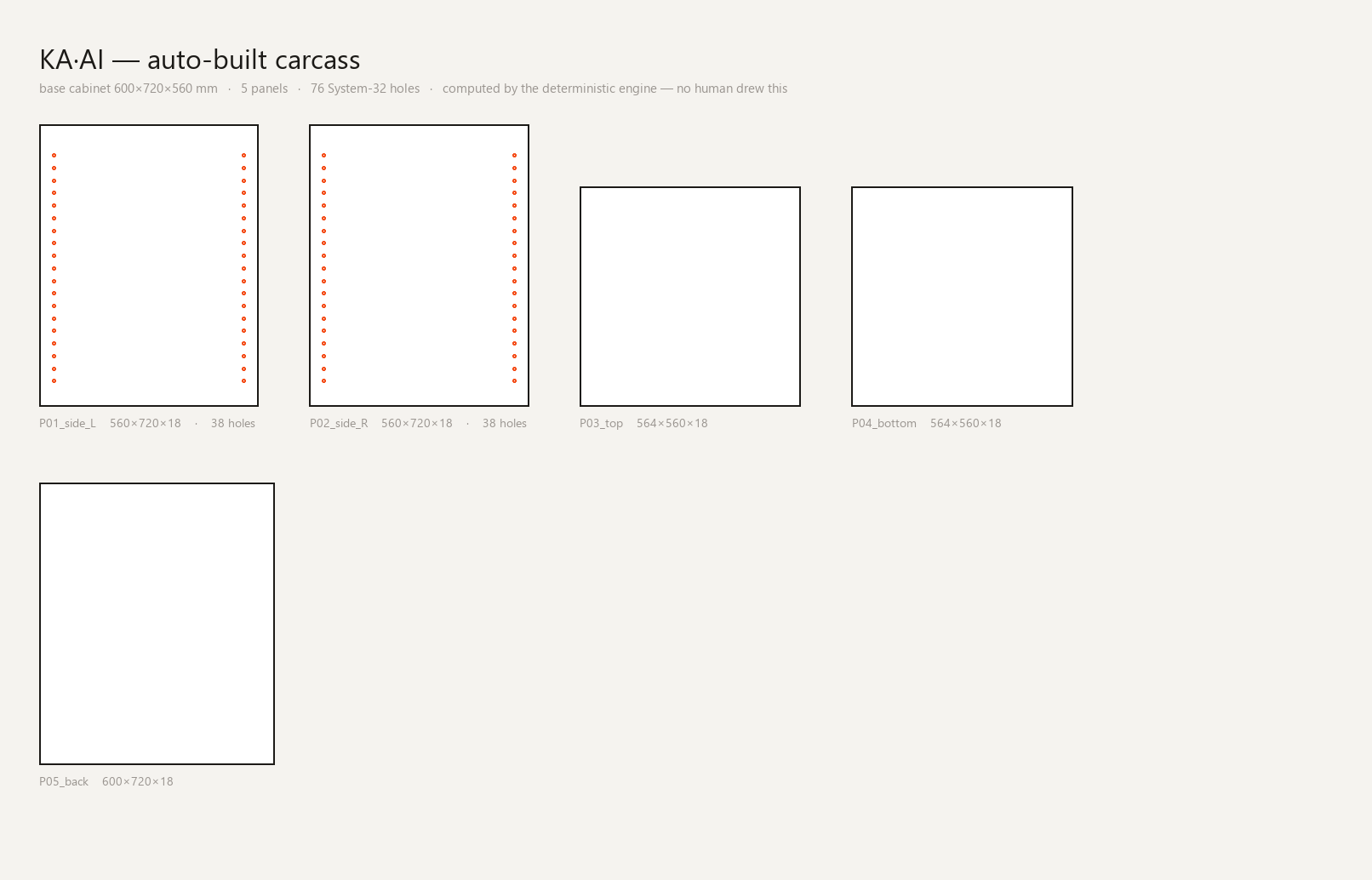
Per model, Kerf emits the complete factory package:
the cut-list (every panel, kerf-aware nested), System-32 drilling maps, the hardware BOM,
3D placements with the interference proof, and the machine files below. These samples are the real,
current outputs — open them in any CAD / CAM tool.
 See every model it has built →
// Honest standing — is this an engineering company yet?
Process — yes
Every number cites an authoritative source, every rule carries a drift-guard test, the crash gate proves assemblies, failures are loud. More written discipline than many small workshops.
Coverage — growing
Expert today in melamine-faced chipboard casework. The gap queue above is exactly what a factory QA office would still ask — one discipline lands daily.
Physical — not yet
No prototype has been cut, loaded or dropped; no licensed engineer stamps these drawings. The first manufactured pieces feeding corrections back into the knowledge base are what close this gap — reality is the only auditor above this one.